A platform that turns scattered neuroscience knowledge into evidence you can query.
BrainKB structures and organizes scientific knowledge using knowledge graphs (KGs) — delivering evidence-based insights with provenance. Every assertion is traceable, every contribution reviewable, every dataset connected.
Structured Knowledge
Capture neuroscience findings as structured, queryable evidence in a shared knowledge graph.
Data Exploration
Search, visualize, and analyze the graph through accessible, interactive tools.
Community Contribution
Researchers contribute, review, and validate evidence with provenance.
Collaboration Hub
A common workbench for neuroscientists to build on each other's findings.
Drive BrainKB from your AI assistant
Use the MCP server directly with Claude or any MCP client — or the BrainKB skill, which runs on the same MCP with guided workflows. Either way you ingest, search, and explore the graph in natural language, as yourself and under your own permissions.
Explore MCP & skill →Browse the neuroscience landscape.
AbstractAtlas maps thousands of neuroscience abstracts — OHBM 2026 and NeuroScape PubMed 1999–2023 corpus — into an interactive 2D/3D UMAP projection. Search semantically, filter by facet, and see where any study sits within the wider literature.
Open AbstractAtlas →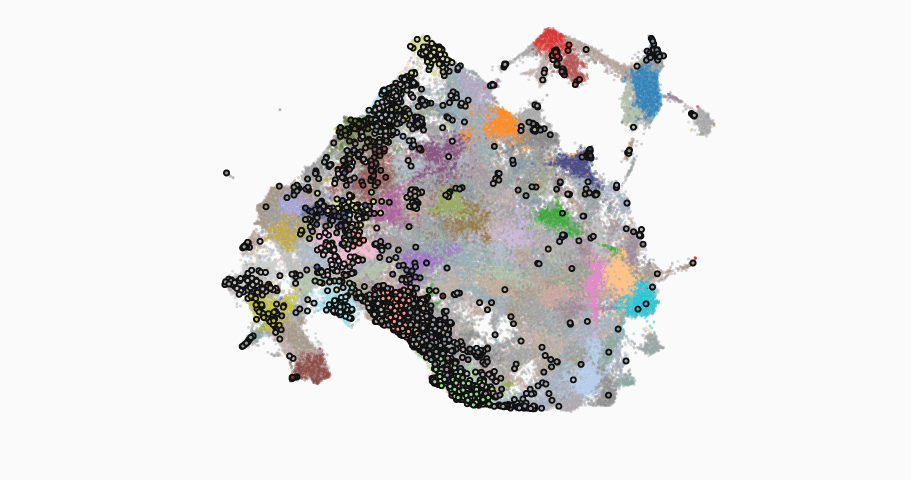
BrainKB Tools
Open, modular tools that integrate with BrainKB applications or operate independently within your own research pipelines.
View all tools →
A task-agnostic agentic framework for structured information extraction from text and documents — with human-in-the-loop evaluation and benchmarking.

PRISMA-guided literature review — from search strategy to screening, critical appraisal, and synthesis — orchestrated across multiple LLMs.
Turn meeting audio and notes into actionable knowledge graphs — extracting decisions, action items, and key concepts automatically.
Map terms and concepts to standardized ontologies for consistent, interoperable, and machine-readable knowledge representations.
Use Cases
Where the toolkit meets real research. Each use case is developed in the open — with public inspection, interaction, and feedback at every stage.
How use cases work
Three open phases combine into one transparent knowledge-management system.
Data-provision mechanisms — public or member-only — depending on the use case.
Accessible interfaces for exploring and interacting with the knowledge graph.
Community-driven validation mechanisms keep the graph trustworthy.
Watch BrainKB's tools work in practice.
From a raw meeting recording to a structured, queryable knowledge graph in minutes — see how MeetGraph captures decisions, action items, and key concepts automatically.
Watch on YouTube →Structured Models
View all models →These models provide the shared structure behind BrainKB's graph, tools, and use cases.
Genome Annotation Schema
A data model designed to represent types and relationships of an organism's annotated genome.
Anatomical Structure Schema
A data model designed to represent types and relationships of anatomical brain structures.
Library Generation Schema
A schema designed to represent types and relationships of samples and digital data assets generated during multimodal genomic data processes.
Evidence Assertion Ontology
A data model designed to represent types and relationships of evidence and assertions.
Powered by advanced AI agents.
BrainKB runs on cutting-edge agentic frameworks. StructSense enables sophisticated structured-information extraction; SynthScholar extends it to PRISMA-guided literature synthesis and critical appraisal across multiple LLMs.
Chhetri, T.R., Chen, Y., Trivedi, P., Jarecka, D., Haobsh, S., Ray, P., Ng, L. and Ghosh, S.S., 2025. STRUCTSENSE: A Task-Agnostic Agentic Framework for Structured Information Extraction with Human-In-The-Loop Evaluation and Benchmarking. arXiv preprint arXiv:2507.03674.
See Research Paper →